Performance art residencies: where live work gets made
Many performance art residencies favour local artists and end in a public showing. What that means for applying, what the space needs, and where else to look.
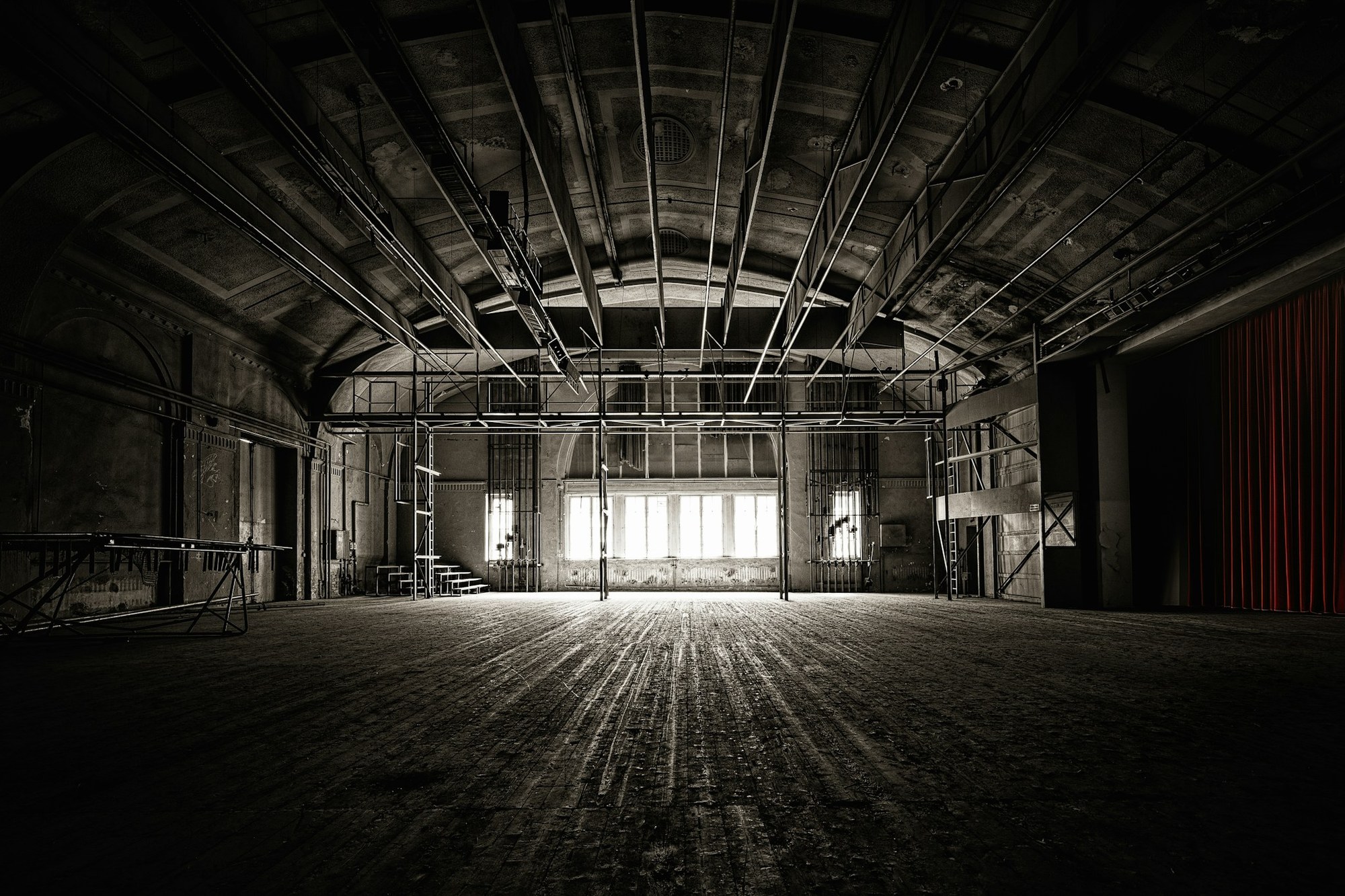
What a performance residency gives you that a studio residency doesn't
A painter on a residency needs a room. A performance artist needs a room and, sooner or later, people in it.
That difference explains a lot of what you'll find when you start looking for a performance art residency. Studio residencies sell time and quiet. Performance residencies sell rehearsal space plus a moment where the work meets an audience: a sharing, a work-in-progress night, a festival slot at the end of the run. If you're new to residencies in general, the full guide to artist residencies covers the basics. This one is about the parts that only apply to live work.
Look at what the programs on the first page of a search actually offer. The Barrow Group in New York gives selected artists a studio for rehearsals and a public sharing, a staff member to help plan it, and front-of-house help on the night. The residency may end in a reading, a scene sharing or a small production. The Center for Performing Arts in Minneapolis has hosted residencies for 25 years, and its 2025-26 cohort's year ended with a presentation at its Spring 2026 New Works Festival. Arts + Public Life in Chicago gave its 2024 residents rehearsal, workshop and performance facilities at the Green Line Performing Arts Center.
At the Barrow Group and CFPA, the showing is written into the residency. That's worth more than it sounds. A rehearsal room can often be hired. Somewhere to show a piece while it's still unfinished, in front of people who came on purpose, is much harder to arrange on your own.
Why many of them favour local artists
The second thing you'll notice is how many of the performance art residencies near the top of a search are aimed at people who already live nearby.
The Barrow Group's program is for NYC-based theater artists. Arts + Public Life prioritises Chicago-based artists and collectives, especially work that's relevant to the South Side, and its 2024 cycle took three residents for ten months. A likely reason: a residency that ends in a public event is partly a program for the venue's own audience, and venues build audiences from the people around them.
This changes how you search and how you pitch.
If you live in a city with an active performance scene, start with your own venues. A local residency can come with a real venue and a real audience, which is hard to get anywhere else.
If you're looking to travel, check whether accommodation is included. Some performing-arts residencies offer the space only.
If a program asks how your work connects to the area, that's a real question. A pitch that names who you expect to come and how you'll reach them will read better than one that only describes the piece.
For a sense of scale, the Artist Communities Alliance counts over 160 residency programs in the US and Canada open to dancemakers, and notes that only some have dedicated dance and performance studios. The rest may still work for research, planning or experimenting in unconventional spaces.
What the space needs to have
Performance covers a wide range of practices, and a space that suits one may not suit another. A theatre company needs a different room from a solo durational artist or someone making a site-specific piece in a field. Before you apply, work out which of these actually matter for the piece you're making, then ask about them directly.
The floor comes first. If you move, the floor is the most important thing in the building. Concrete is hard on the body over weeks of rehearsal. A sprung or wooden floor is a different experience. Ask what's under the space, not just how big it is.
Then height and clear space. Measure your piece. If you work with rigging, aerial equipment, large objects or projection, ceiling height and open floor area decide whether it fits at all.
Sound: can you be loud, and at what hours? Is there a PA, or do you bring your own? Rural spaces are often more forgiving on volume than city buildings with neighbours.
If lighting is part of the work, ask whether the room can be blacked out and whether there's any lighting rig. Many good rehearsal spaces are full of daylight, which is lovely until you need it gone.
Documentation is the one people forget. Live work disappears unless someone records it, and your next application will probably ask for video. Ask whether the program helps with documentation, or plan to bring your own camera and someone to run it.
Last, time in the room. Shared spaces get scheduled. "Studio access" might mean the room is yours all day, or it might mean two evenings a week. Ask how many hours are actually yours.
None of this needs to be awkward. Most hosts won't mind, and a precise question tells them you know what you're doing. The same goes for any residency you haven't heard of before: it's worth spending ten minutes to vet a residency before applying.
Performance art residencies outside the theatre world
Not all performance art wants a black box. Durational, site-specific and participatory work can do better somewhere that isn't a venue at all, and some performance residencies happen in places that would never call themselves theatres.
The Center for Performing Arts ran a site-specific residency in 2023 and has supported a solo durational piece built around endurance. Away from the US, some rural and independent spaces take performers alongside visual artists and writers. A few of the spaces listed on Artaway show the range.
Land of Enchantment, on the Costa da Morte in Galicia, has a 35 m² sound and movement studio with a PA, runs performance nights with the local community, and ends its one-month residency with a shared exhibition and performance night.
Pueblos en Arte in Torralba de Ribota, Aragón, hosts mainly circus and theatre, taking companies of up to five people for one continuous month. Its open call is aimed at artists living outside Spain.
A self-directed residency in a cork oak forest in the Sierra de Aracena has a 300 m² communal studio with mobile panels and is open to performers, with no project or outcome required.
That's a short list, and we'd rather say so than pretend otherwise. Most residencies on Artaway are aimed at studio practice, so performance hosts are a minority. The ones that suit live work offer what a city rarely does, which is room and quiet, and in Land of Enchantment's case a local audience at its performance nights.
Money: free space, paid stays and the "free if your show is free" deal
Performance art residencies fall into roughly three money models, and it helps to know which one you're looking at.
The first is donated space with no stipend, which is common at city venues. The Barrow Group offers donated rehearsal and performance space and charges no fee to apply. You get the room and the showing. No stipend is mentioned, so assume you cover your own living costs.
The second is space in exchange for free public programming. Arts + Public Life gives residents access to its facilities at no cost if their programming is free to the public. It's a fair trade and a common one: the venue gets free events for its community, you get the room. Just budget for the fact that you won't earn ticket income.
The third is the self-funded stay. Many rural and international residencies charge a fee. The cork oak forest residency above, for example, listed €820 per month per artist at the time of writing (October 2026), or €700 each as a duo.
Funded places do come up, but none of the programs above advertise a stipend, so look for funding through open calls rather than expecting it. Our guides to free residencies and paid residencies go through how each kind works and where the catches are.
Pitching a host that isn't a venue
If you want a residency on your own terms, the alternative is to approach a space directly. A farm, a retreat house, a cultural association or a rural guesthouse may never have hosted a performer, but many of them have a barn or a hall, and some would be glad of a reason to bring people together.
This is where performance art has an advantage over most disciplines. You can offer something a host can actually use: a performance for their guests or neighbours, a workshop, a site-specific piece made for their land. That's a clearer exchange than "I'd like to paint here for a month".
A few things make the pitch work. Say exactly what you need from the space: floor area, hours, sound, whether you'll be working at night.
Say what the host gets and when. "One public performance in the last week, free to attend" is specific. "Community engagement" is not.
Be honest about the practical side. If the piece involves fire, water, nudity, loud sound or late nights, say so up front.
Offer documentation. Hosts like having photos and video of something that happened on their property.
If you haven't done an arrangement like this before, it's worth reading how to prepare for an art exchange so expectations are written down before you arrive. You can also browse hosts and look for the kind of space your work needs. The music residency guide covers a lot of the same ground for sound-based practice.
Frequently asked questions
Are performance art residencies paid? Rarely, from what we found. The programs we looked at offer donated space, or free space in return for free public events, rather than a stipend, and many rural residencies charge a fee. Check each open call for funding before you assume it.
Can a group or company apply together? Sometimes. Pueblos en Arte, for example, takes companies of up to five people. Check each program's guidelines before you apply, because some are built for one person and a room.
Do I have to perform at the end? At several programs, including the Barrow Group and CFPA, a public sharing or presentation is part of the residency. Self-directed residencies, like the cork oak forest one, ask for nothing. Ask before you apply, because a month that ends in a show is a different month.
Is a performance residency the same as a Las Vegas residency? No. When a singer "does a residency" in Las Vegas, it means a run of concerts at one venue. An artist residency gives you time and space to make new work. Same word, two different things, which is why search results for one often turn up the other.
Related guides
- Writing Residencies: How They Work and How to Apply
- Illustrator Residency Programs: A Practical Guide (2026)
- What Is an Artist Colony? History, Modern Equivalents, and How to Find One
- Virtual Artist Residencies: How They Work, What They Cost, and Whether They're Worth It
- What Is a Music Residency? Programs, Funding and Applications
- Ceramics Residency Programs: How They Work and How to Apply
- Fiber Arts and Textile Residencies: How They Work and What They Cost
- Paid artist residencies: how the money actually works
- Free artist residencies: what "free" actually covers
- Printmaking residencies: finding one with the right press
Ready to get started?
Browse self-funded, funded, and exchange artist residencies on Artaway.
Explore opportunities